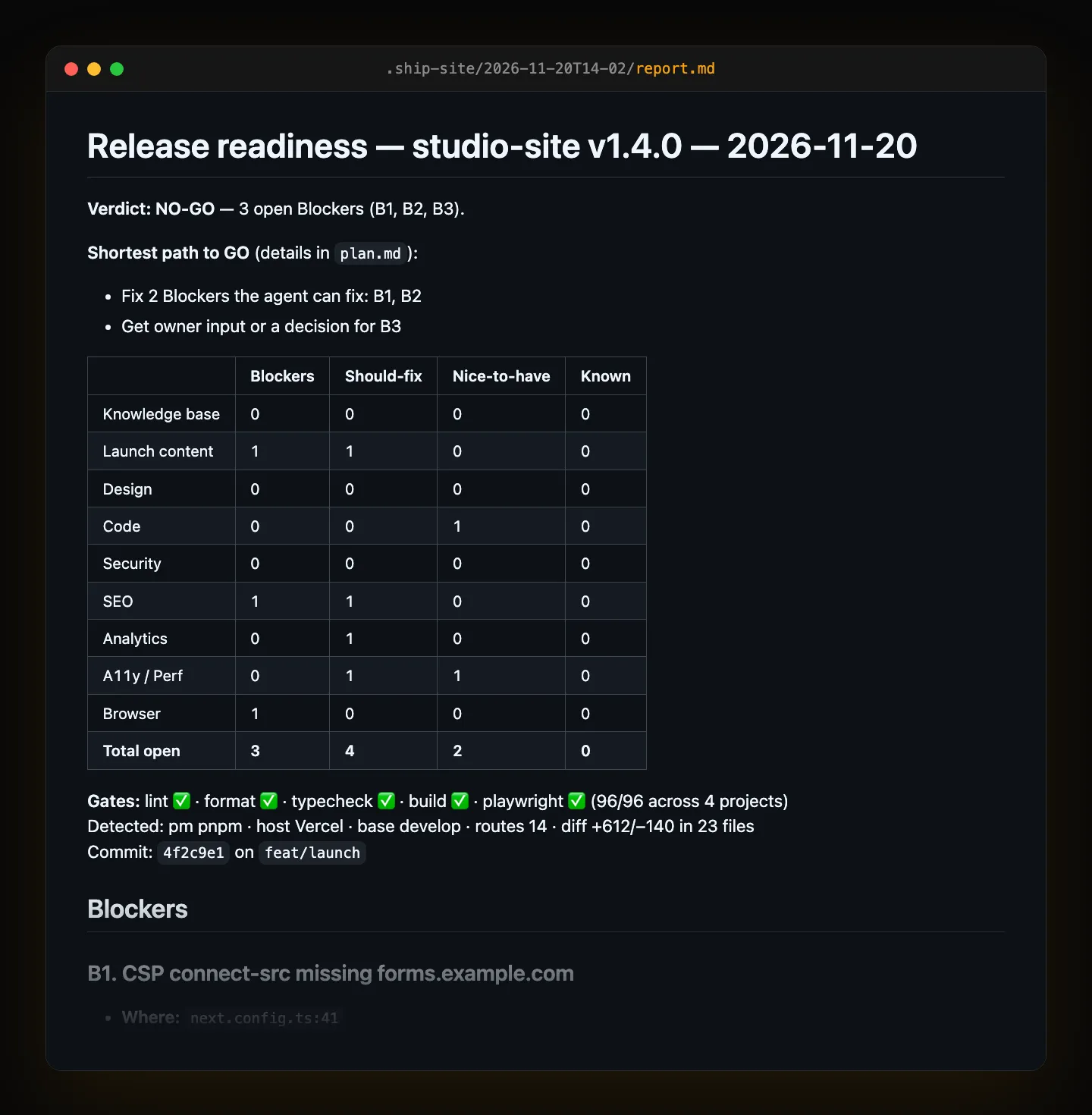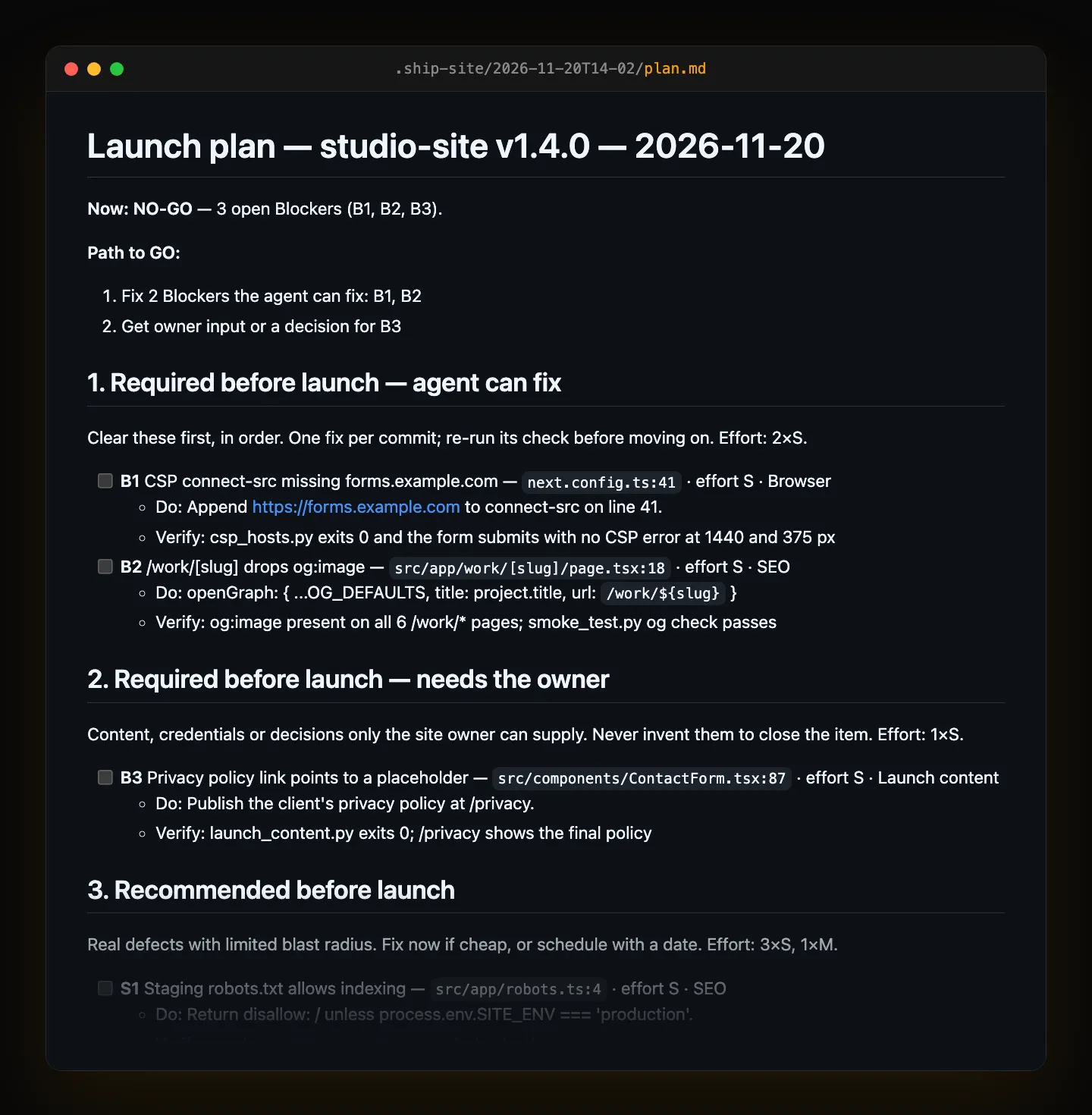
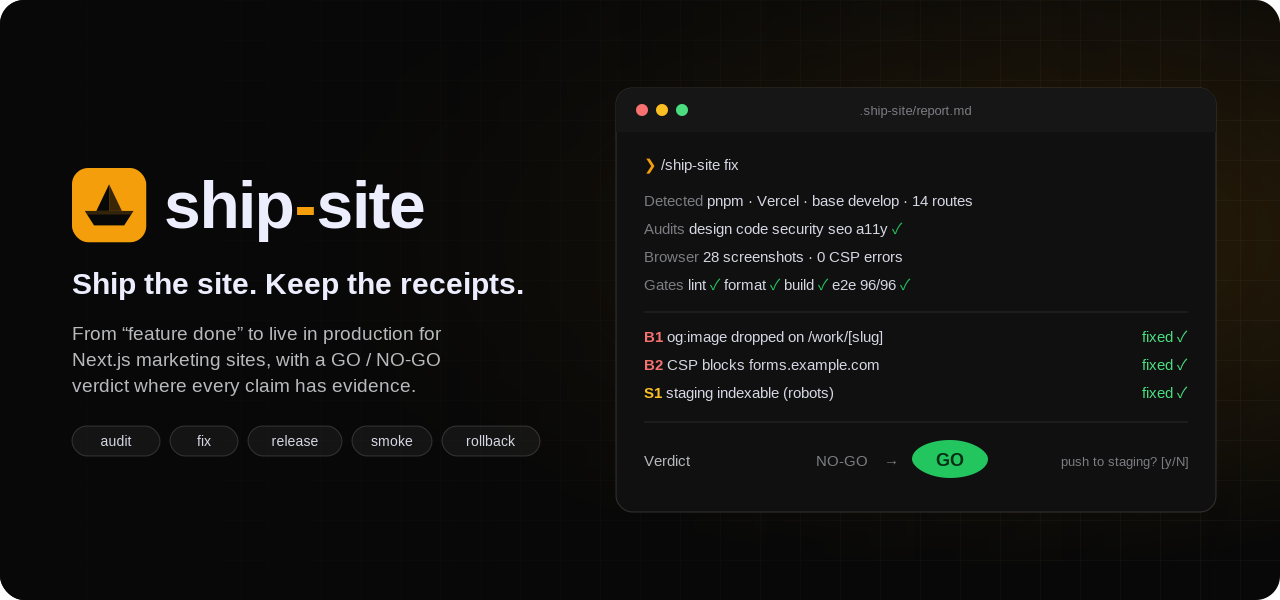
Ask your coding agent “is this ready to ship?” and ship-site answers it properly. It reads your site, runs the design, code, security, SEO, analytics, accessibility and performance audits in parallel, clicks through every route in a real browser, runs your tests and build, and hands back a go/no-go report and an ordered launch plan. Every claim in them carries evidence: a screenshot, a log line or a test name.
Say “ship it” and it carries on through staging, the version bump, the release PR, the tag and a post-deploy smoke test, stopping to ask before every step that leaves your machine.
The problem it solves
It replaces the release checklist people run by hand and get wrong at 6pm on a Friday: an og:image silently dropped by a metadata merge, a content security policy that blocks the contact form, a staging site Google is indexing, or a “passing” form test against a mocked backend.
What you get
Every run writes two files you can hand to a developer or a client:
report.md: the verdict and the evidence behind it. Findings are ranked blocker, should-fix or nice-to-have, each with a file and line, a code-level fix, an owner, an effort size and a verify step. It also lists what passed and what wasn’t checked, so a skipped audit can’t pass for a clean one.plan.md: the ordered route to go. It splits agent work from owner inputs, the content, credentials and decisions only the client can supply.
Finding IDs stay the same across re-runs, so “B2 is done” means the same thing in the report, the plan, a commit message and a chat with the client.
What it checks
- Launch content: placeholder copy, starter-template leftovers, favicon and social image, 404 pages, and links back to an old site.
- Security: a content security policy that covers every external host, no secrets in public environment variables, and security headers.
- SEO: per-route metadata, sitemap and robots, staging kept out of search, structured data, heading outline and alt text.
- Accessibility and performance: WCAG 2 A and AA on every route, keyboard and focus, reduced motion, and Core Web Vitals.
- Browser: every route at 1440 and 375 pixels for console errors, failed requests and broken forms.
- Replatforming: every URL of the site being replaced still resolves on the new one.
It works across Next.js, Astro, Nuxt, SvelteKit, Remix, Gatsby, Hugo, Jekyll, Eleventy, Vite apps and plain HTML.
Safe by default
The skill acts only after you say yes. It stops and asks before every push, pull request, version bump, tag, host rollback or real form submission, and one approval covers one action. It never invents copy, bios, metrics or legal text to close a finding. Those go on the owner-inputs list instead.
Try it
ship-site works with Claude Code, Codex, Gemini CLI, Cursor, Copilot and OpenCode. In Claude Code, install it as a plugin:
/plugin marketplace add saroj-shahi/ship-site
/plugin install ship-site@ship-site
For other agents, run npx skills add saroj-shahi/ship-site. The README on GitHub has every mode, the standalone scripts and a sample run.